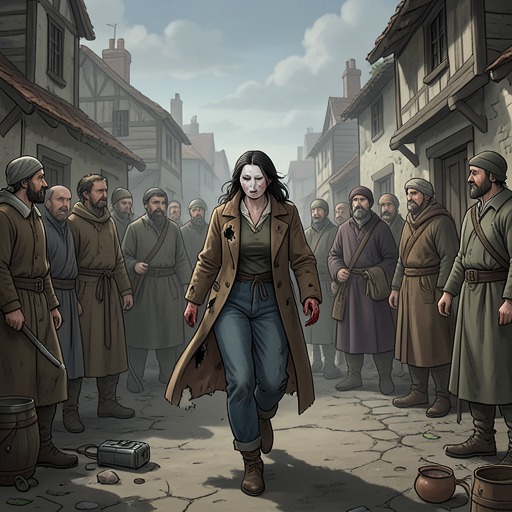
Malorie and Tom (deceased companion)
Bird BoxMalorie and Tom (deceased companion) is a bond that persists after Tom’s death through voice, memory, and the practical legacy of his efforts to keep others alive. At the Jane Tucker School for the Blind, the recording meant to guide Malorie also makes his absence unmistakable; her private recollection, in turn, restores the man behind the voice as someone whose mind was always working and who kept trying because he loved living.
A voice carried into the future
Years before Malorie reaches the school, Tom’s voice reaches her over a phone. For four years she wonders whether she will ever hear it again. The length of that uncertainty makes the voice more than a useful signal: it is the surviving trace of a relationship she has had to carry without knowing whether it might return in any form.
At the school, the recording does return, but not as a conversation. Rick asks whether the man on it is with Malorie. She answers that he is dead. Tom’s voice has brought her to a community, yet the question forces the difference between guidance and presence into the open: the recording can direct a living person through danger, but it cannot restore the person whose words it preserves.
Tom’s voice as a guide
Rick explains that the school contacted people over the years, though fewer than expected, and could not know how many remained alive or sane. The community expected Malorie to travel down the river. It used Tom’s voice both to tell her she had arrived and to let other strangers learn that some kind of civilization lay beyond the fence. Because Rick did not know Tom was no longer with her, he apologizes for using the recording.
The voice therefore serves two audiences and two purposes. For Malorie, it is an arrival signal shaped around the particular journey she has made; for unknown travelers, it advertises the existence of a refuge. The arrangement turns the intimate sound of a dead companion into a public instrument of survival. Its usefulness does not lessen its emotional cost: when Rick asks whether Tom is there, the question makes the recording’s original function collide with the fact that its speaker cannot accompany her.
Bereavement and remembered character
Tom’s death is stated plainly, and Malorie’s rigid answer comes while she scans the hall, still unwilling to trust what she has reached. The scene does not make reunion possible through the recording. Instead, it places Tom’s absence inside the fragile relief of arrival, where safety has not yet become simple enough to erase caution or grief.
Later, as tears come, Malorie thinks of the housemates and their shared work and hardship. Among those memories, Tom stands out not only as a voice preserved on a recording but as a person in action: his mind was always working, solving a problem, always trying. She also remembers his love for living. Those qualities give emotional meaning to the recording’s practical afterlife. The signal that guides Malorie onward reflects the same persistence she recalls in Tom, without pretending that a message can replace the man.
The bond’s final significance
At the school, other people emerge into the hall, and Rick places a hand on Constance’s shoulder as they move farther into the facility. The group gives Malorie and her children a moment to themselves. In that pause, Tom is present neither as a returned companion nor merely as an announcement over a recording: he remains part of the life Malorie has brought to this threshold, remembered alongside those who helped her endure.
The relationship’s ending is thus both loss and continuation. Tom is dead, and Malorie says so; the voice that once belonged to him has been put to work by people who did not know he was gone. Yet the memory she keeps is more intimate than the recording’s instructions. She remembers his restless problem-solving and his love of life, traits that make his influence legible in the survival that carries her forward. The bond persists not by canceling death, but by joining what Tom left behind to the person Malorie remembers him to have been.